La Leche League gets some good publicity thanks to Angelina Jolie and this picture of her breastfeeding one of her twins on the front of W magazine. (Click on her name for the video).
Are celebrity breastfeeding mothers any more worthy of note than the mothers who do this every day? Of course not. But the more that breastfeeding is portrayed as normal, the happier I am.
Tuesday, October 14, 2008
LLL and Angelina!


Friday, October 03, 2008
One vote and $80,000 could go to La Leche League!
Quick! Go to the link below before October 15th, scroll down and vote for La Leche League. Every vote guarantees $2 to LLL, and there is $80,000 to be given away!
Click this link.
It only takes a few seconds, and helps such a worthy cause!
Saturday, September 27, 2008
Survey of Mothers' Sleep & Fatigue
Survey of Mothers' Sleep & Fatigue
by Dr. Kathleen Kendall Tackett and Dr. Thomas Hale
You are eligible to participate in this study if you currently have a baby or child 12 months of age or younger.
In this survey, they will be asking you some detailed questions about how well you and your baby sleep, where members of your family usually sleep, and how tired you feel on most days. They will also ask you some questions about things that can interfere with sleep. There are very few studies on this important topic, and they will use the results for a research study.
Click HERE for the survey.
Friday, September 26, 2008
Academy of Breastfeeding Medicine Press release
Toll From Tainted Chinese Formula Climbs to 53,000; Producer Received Complaints in 2007
New Rochelle, NY, September 25, 2008 – The number of infants in China who have fallen ill as a result of formula tainted by melamine, has reached 53,000 and is responsible for the deaths of at least three infants. (New York Times, September 24, 2008)
A report released by the Xinhua News Agency indicates the Sanlu Group, the producer of the tainted formula, had received consumer complaints about their product as early as December 2007, and repeatedly made efforts to hide information about possible contamination. Melamine, a chemical compound used mainly as a fire retardant, has been identified as the contaminant in the formula which has now led to the recall of Chinese-made dairy products in China and other parts of Asia as well.
In response to these continuing reports of tainted Chinese baby formula, the Academy of Breastfeeding Medicine urges public agencies worldwide to renew education and support for breastfeeding. The tragic and unnecessary deaths of infants in China , and the sickening of thousands of others, remind us of a truth health experts have long understood: with extremely rare exceptions, breastmilk is unquestionably the safest method of infant feeding. Much attention has been focused lately on ways in which food and other supply chains in China should be more carefully monitored and regulated, a problem which has proven to be ubiquitous, deeply engrained in the Chinese economy, and thus far highly unmanageable.
In the case of infant feeding, however, very little has been said about what would appear to be the most effective long-term strategy to protect infants against future feeding catastrophes, namely, the promotion of breastfeeding. The melamine scandal, together with the terribly catastrophic earthquake that ravaged so many Chinese communities last May, should have demonstrated to China and to the entire world that breastfeeding is a practice that all societies should cherish, safeguard, and promote. This stark reminder of the potential dangers of artificial milk, underscores the importance of promoting, protecting, and supporting breastfeeding worldwide.
Dr. Caroline Chantry, President of the Academy of Breastfeeding Medicine, pointed out “ China is not the first, or only country to fall prey to contaminated baby formula. But we must make it the last. And we do know how.”
According to the World Alliance for Breastfeeding Action (WABA), a recent decline in funding world-wide for public education and training of health professionals to support breastfeeding, has resulted in a decline of hospitals implementing the WHO/UNICEF Baby-Friendly Hospital Initiative. The Initiative incorporates ten steps for successful breastfeeding, and forbids the unethical promotion of beastmilk substitutes in health facilities. And the Academy of Breastfeeding Medicine continues to promote professional education through its conferences, publications, and its peer-reviewed journal Breastfeeding Medicine.
The Academy of Breastfeeding Medicine is a worldwide organization of physicians dedicated to the promotion, protection and support of breastfeeding and human lactation through education, research, and advocacy. An independent, self-sustaining, international physician organization and the only organization of its kind, ABM ’s mission is to unite members of various medical specialties through physician education, expansion of knowledge in breastfeeding science and human lactation, facilitation of optimal breastfeeding practices, and encouragement of the exchange of information among organizations.
Thursday, September 25, 2008
Melamine and breastfeeding
From Dr Thomas Hale, author of Medications and mother's milk
"I've also been asked by a couple of mother about breastfeeding and
melamine. This is what I've replied.
No one knows the correct answer to this because here has been no
research done on melamine and breastfeeding. Thus all anyone can do is
give an educated guess. Research, however,shows consistently that even
in a polluted world, breastfeeding offers advantages that outweigh the
risk of ingesting possible contaminants. Indeed, the benefits of
breastfeeding may prove to be essential to compensate for and outweigh
the risks of toxic effects from the environment. In other words even
when small amounts of toxins get into the breast milk medical problems
are not found in the babies.
For example breastfeeding helps to diminish toxins bad effects. Here
are some facts:
Toxins increase the risk of developing some cancers. True, but the
evidence shows that breastfeeding babies have a lower risk of some
cancers than artificially fed babies.
Toxins may interfere with neurological function and learning abilities.
True, but the evidence shows that children who were breastfed do better
on neurological and intelligence tests than artificially fed children,
and the longer they are breastfed, the better they do.
Toxins may interfere with immunity. True, but the evidence shows that
infants who are breastfed have better and more mature immunity than
artificially fed infants, and that this better immunity carries on much
longer than the length of time the infant or child is breastfed.
I hope this puts your mind at ease and you can continue to enjoy your
breastfeeding relationship."
Thursday, September 18, 2008
Tainted milk kills babies in China
It is such a tragedy that so many babies in China have been affected by the tainted milk powder. While the parents, companies and government point fingers and argue, where is the mention of BREASTFEEDING? Where is the talk of the reasons so many babies are not getting milk from their own mothers?
I wish the headlines of the newspapers in China (and the rest of the world) would read
BREASTFEEDING: THE ONLY SAFE WAY TO FEED YOUR BABY
Why risk your baby's health?
Why would you NOT breastfeed?
Can you really trust ANY milk manufacturer more than your own breasts?
Friday, August 29, 2008
Feeding frenzy from The Guardian 27/8/08
Interesting article from the Guardian newspaper on the importance of human milk vs cow's milk formula. Should babies receive another mother's milk if they can't receive it from their own mother?
Why not?
Feeding Frenzy
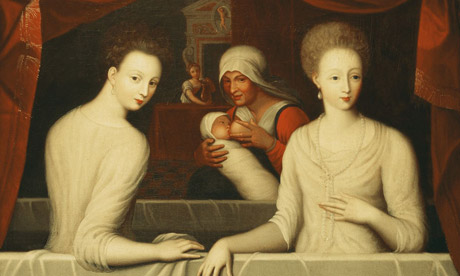
Kate Garraway's revelation that she would feed her child another woman's breast milk has caused a furore - some people have called it repulsive. But given the health benefits, asks Joanna Moorhead, why all the fuss about wet-nursing?
Joanna Moorhead
Wednesday August 27 2008
The Guardian
At the weekend, GMTV presenter and mother of one Kate Garraway admitted that
she used to think that feeding other women's babies sounded pretty strange;
"a bit icky", was the way she would have described it. But making a Channel 4 documentary on the subject, and meeting women in the UK and US who had fed other women's offspring, she was prompted to rethink the entire debate. "Why are we happy about giving [our babies] something from a cow's breast, which is another species?" Garraway asked bullishly in a Guardian interview on Saturday. She continued to say that it was, in fact, "bonkers" to feel that letting your baby ingest another woman's
milk is beyond the pale, while being happy to let that same baby ingest cow's milk - "which is what formula milk is".
But many people still feel that babies receiving sustenance from any woman
other than their mother is deeply worrying and suspect. Among those who have
commented on the subject online over the past few days are a number of people
who have pronounced themselves "uncomfortable" at the notion. One mother I spoke to told me she felt "repulsed" at the idea of giving her milk to another baby, or having her baby fed with what is, after all, another woman's bodily fluid. Others feel that it could be psychologically undermining. "I think it would make me feel inadequate," says one friend. "There's so much pressure on you to breastfeed. If you find it
difficult, and ask another woman to do it for you, that would just reinforce the
inadequacy you're already feeling." I must admit that, the one time I tried swapping babies with a close friend, feeding her little boy felt weirdly intimate. The baby was hers, not mine: being in such close contact with him felt odd. His suck didn't feel anything like my baby's suck, and the whole experience made me feel a bit uncomfortable.
Alongside the detractors are those who find the idea perfectly normal.
"The words teacup and storm spring to mind," said a contributor to one
blog. Another pointed out that breastfeeding a child who wasn't your own was
once considered perfectly acceptable, with wet-nursing widespread just a few
hundred years ago. And while there's every reason to have been perturbed by
the class relationships that defined that practice in the west - working-class
women feeding the children of the upper classes - it could be argued that the
sharing of the breast milk itself wasn't actually such a problem. The reality is, kneejerk reactions apart, that research paper after research paper extols the health virtues of breast over formula milk. A baby who receives breast milk is less likely to suffer respiratory infections, gastroenteritis, urinary tract infections, ear infections or eczema. He or she is less likely to be overweight as a teenager and adult, is less likely to develop diabetes, and is likely to have a higher IQ. The list seems endless : so is the supplier really so important, provided the baby is receiving breast milk?
Among infant feeding professionals this current controversy is being met with a
guarded response. Many of those I spoke to had been approached by the makers of
Garraway's Channel 4 documentary but had declined to take part, fearing that - as happened with a similar documentary two years ago, focusing on mothers who breastfeed children as old as eight - the result would be a film that highlighted the crackpot and the batty, rather than the mainstream issues.
Alison Baum, of the breastfeeding charity Best Beginnings, expresses a typical
view. "There is value in making clear, as Garraway does, that formula is based on cow's milk - I think a lot of people don't realise that, and it does have mplications ... cow's milk is made to feed big baby calves, and we're giving it to tiny human infants. But there's a difference between acknowledging that there's an issue here, and seeing wet-nursing as the solution - I don't think that's the answer at all.
"What it's all about, for me, is shifting the pressures off individual women and on to society, so mothers themselves don't feel the weight of the debate so much. What I want to do is make it possible for mothers to go on breastfeeding for as long as they want to - because, at the moment, far too many women are stopping earlier than they would like."
Insiders say that some of Garraway's comments are misinformed, as well as naive. At one point in the Guardian interview, she says that despite her views having changed, she doesn't feel she'd be able to deal emotionally with another woman feeding her baby. So, she says, if the circumstances arose she'd simply buy human milk for her baby - from a milk bank.
What can she mean, asks Janet Fyle, professional policy advisor at the Royal College of Midwives. I suggest that maybe she's imagining that she'd call up one of the country's 17 milk banks, located at hospitals across Britain, credit card at the ready. Fyle snorts with laughter. "Is that what she means? Bless her!" she chuckles. Milk banks - which dwindled through the 1980s at the height of the Aids furore, but are now making a comeback - are specifically designed for the feeding of the tiniest premature babies in special-care baby units. These babies weigh as little as 2lbs, and have minute stomachs, so they need to be tube-fed a few millimetres of donated breast milk every few hours through a tube.
"It's a totally different ball-game from feeding a growing baby at term and beyond," explains Sally Inch, coordinator of the Oxford Human Milk Bank and infant feeding specialist for the Oxford Radcliffe Trust.
"A normal-size newborn would need something in the region of three-quarters to a litre a day of milk. It simply wouldn't be practical - and, more importantly, it's not what breast-milk banks exist to do."
What they are set up for, Inch explains, is to give premature babies the only milk they may be able to absorb - the gut of a pre-term infant is often too immature to tolerate any kind of formula. So do mothers of premature newborns ever get squeamish about their babies being given other mothers' milk - albeit after careful screening and pasteurisation? "That's certainly not a major problem," says Inch. "This milk can be life-saving - it's the best way of protecting against a condition called necrotising enterocolitis, which kills one in five premature babies who contract it. Who would mind their baby being given something that's going to save his or her
life?"
A much more common problem, she points out, is that milk banks don't have enough milk to meet demand, especially with premature birth on the increase. Women who donate milk have babies under six months old themselves - they usually collect a small amount of milk from each breast after each feed, and then freeze it to give to the milk bank later.
But what about modern-day, mouth-to-nipple wet-nursing - does it really go on,
behind closed doors? Fyle thinks it probably does. From time to time, she says,
the Royal College of Midwives gets an inquiry from someone who wants to know if
there are risks involved. (Since women are screened for conditions such as HIV
and hepatitis during pregnancy these days, there doesn't tend to be a huge health risk. If a woman is feeding her own baby, she's almost certainly no great risk to yours.) "There are probably situations in which women help one another out by feeding each other's babies," she says. "It happens all the time in Africa, and it happened all the time in the past in the west. But as far as the future is concerned, in the west, I don't think it's going to make a big impact - although I am a bit worried about the possibility of it happening for gain. I feel there are mothers out there who don't like the idea of using their own breasts for feeding, but feel for
health reasons they'd like their child to have breast milk. I wouldn't rule out a bit of a growth in wealthy women looking for women they could pay to feed their babies," she pauses. "I do find that disquieting."
The reality, though, is that while this may occasionally happen, the current furore says a lot more about the media interest in the extremes of human behaviour than it does about real issues around breastfeeding. Right now, only 2% of British babies are being exclusively breastfed to six months, as per official government advice. As far as I know, no one's making a documentary about that.
Copyright Guardian Newspapers Limited 2008
Subscribe to:
Posts (Atom)

