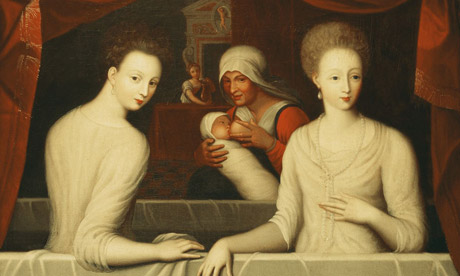
Interesting article from the Guardian newspaper on the importance of human milk vs cow's milk formula. Should babies receive another mother's milk if they can't receive it from their own mother?
Why not?
Feeding Frenzy
Kate Garraway's revelation that she would feed her child another woman's breast milk has caused a furore - some people have called it repulsive. But given the health benefits, asks Joanna Moorhead, why all the fuss about wet-nursing?
Joanna Moorhead
Wednesday August 27 2008
The Guardian
At the weekend, GMTV presenter and mother of one Kate Garraway admitted that
she used to think that feeding other women's babies sounded pretty strange;
"a bit icky", was the way she would have described it. But making a Channel 4 documentary on the subject, and meeting women in the UK and US who had fed other women's offspring, she was prompted to rethink the entire debate. "Why are we happy about giving [our babies] something from a cow's breast, which is another species?" Garraway asked bullishly in a Guardian interview on Saturday. She continued to say that it was, in fact, "bonkers" to feel that letting your baby ingest another woman's
milk is beyond the pale, while being happy to let that same baby ingest cow's milk - "which is what formula milk is".
But many people still feel that babies receiving sustenance from any woman
other than their mother is deeply worrying and suspect. Among those who have
commented on the subject online over the past few days are a number of people
who have pronounced themselves "uncomfortable" at the notion. One mother I spoke to told me she felt "repulsed" at the idea of giving her milk to another baby, or having her baby fed with what is, after all, another woman's bodily fluid. Others feel that it could be psychologically undermining. "I think it would make me feel inadequate," says one friend. "There's so much pressure on you to breastfeed. If you find it
difficult, and ask another woman to do it for you, that would just reinforce the
inadequacy you're already feeling." I must admit that, the one time I tried swapping babies with a close friend, feeding her little boy felt weirdly intimate. The baby was hers, not mine: being in such close contact with him felt odd. His suck didn't feel anything like my baby's suck, and the whole experience made me feel a bit uncomfortable.
Alongside the detractors are those who find the idea perfectly normal.
"The words teacup and storm spring to mind," said a contributor to one
blog. Another pointed out that breastfeeding a child who wasn't your own was
once considered perfectly acceptable, with wet-nursing widespread just a few
hundred years ago. And while there's every reason to have been perturbed by
the class relationships that defined that practice in the west - working-class
women feeding the children of the upper classes - it could be argued that the
sharing of the breast milk itself wasn't actually such a problem. The reality is, kneejerk reactions apart, that research paper after research paper extols the health virtues of breast over formula milk. A baby who receives breast milk is less likely to suffer respiratory infections, gastroenteritis, urinary tract infections, ear infections or eczema. He or she is less likely to be overweight as a teenager and adult, is less likely to develop diabetes, and is likely to have a higher IQ. The list seems endless : so is the supplier really so important, provided the baby is receiving breast milk?
Among infant feeding professionals this current controversy is being met with a
guarded response. Many of those I spoke to had been approached by the makers of
Garraway's Channel 4 documentary but had declined to take part, fearing that - as happened with a similar documentary two years ago, focusing on mothers who breastfeed children as old as eight - the result would be a film that highlighted the crackpot and the batty, rather than the mainstream issues.
Alison Baum, of the breastfeeding charity Best Beginnings, expresses a typical
view. "There is value in making clear, as Garraway does, that formula is based on cow's milk - I think a lot of people don't realise that, and it does have mplications ... cow's milk is made to feed big baby calves, and we're giving it to tiny human infants. But there's a difference between acknowledging that there's an issue here, and seeing wet-nursing as the solution - I don't think that's the answer at all.
"What it's all about, for me, is shifting the pressures off individual women and on to society, so mothers themselves don't feel the weight of the debate so much. What I want to do is make it possible for mothers to go on breastfeeding for as long as they want to - because, at the moment, far too many women are stopping earlier than they would like."
Insiders say that some of Garraway's comments are misinformed, as well as naive. At one point in the Guardian interview, she says that despite her views having changed, she doesn't feel she'd be able to deal emotionally with another woman feeding her baby. So, she says, if the circumstances arose she'd simply buy human milk for her baby - from a milk bank.
What can she mean, asks Janet Fyle, professional policy advisor at the Royal College of Midwives. I suggest that maybe she's imagining that she'd call up one of the country's 17 milk banks, located at hospitals across Britain, credit card at the ready. Fyle snorts with laughter. "Is that what she means? Bless her!" she chuckles. Milk banks - which dwindled through the 1980s at the height of the Aids furore, but are now making a comeback - are specifically designed for the feeding of the tiniest premature babies in special-care baby units. These babies weigh as little as 2lbs, and have minute stomachs, so they need to be tube-fed a few millimetres of donated breast milk every few hours through a tube.
"It's a totally different ball-game from feeding a growing baby at term and beyond," explains Sally Inch, coordinator of the Oxford Human Milk Bank and infant feeding specialist for the Oxford Radcliffe Trust.
"A normal-size newborn would need something in the region of three-quarters to a litre a day of milk. It simply wouldn't be practical - and, more importantly, it's not what breast-milk banks exist to do."
What they are set up for, Inch explains, is to give premature babies the only milk they may be able to absorb - the gut of a pre-term infant is often too immature to tolerate any kind of formula. So do mothers of premature newborns ever get squeamish about their babies being given other mothers' milk - albeit after careful screening and pasteurisation? "That's certainly not a major problem," says Inch. "This milk can be life-saving - it's the best way of protecting against a condition called necrotising enterocolitis, which kills one in five premature babies who contract it. Who would mind their baby being given something that's going to save his or her
life?"
A much more common problem, she points out, is that milk banks don't have enough milk to meet demand, especially with premature birth on the increase. Women who donate milk have babies under six months old themselves - they usually collect a small amount of milk from each breast after each feed, and then freeze it to give to the milk bank later.
But what about modern-day, mouth-to-nipple wet-nursing - does it really go on,
behind closed doors? Fyle thinks it probably does. From time to time, she says,
the Royal College of Midwives gets an inquiry from someone who wants to know if
there are risks involved. (Since women are screened for conditions such as HIV
and hepatitis during pregnancy these days, there doesn't tend to be a huge health risk. If a woman is feeding her own baby, she's almost certainly no great risk to yours.) "There are probably situations in which women help one another out by feeding each other's babies," she says. "It happens all the time in Africa, and it happened all the time in the past in the west. But as far as the future is concerned, in the west, I don't think it's going to make a big impact - although I am a bit worried about the possibility of it happening for gain. I feel there are mothers out there who don't like the idea of using their own breasts for feeding, but feel for
health reasons they'd like their child to have breast milk. I wouldn't rule out a bit of a growth in wealthy women looking for women they could pay to feed their babies," she pauses. "I do find that disquieting."
The reality, though, is that while this may occasionally happen, the current furore says a lot more about the media interest in the extremes of human behaviour than it does about real issues around breastfeeding. Right now, only 2% of British babies are being exclusively breastfed to six months, as per official government advice. As far as I know, no one's making a documentary about that.
Copyright Guardian Newspapers Limited 2008
Friday, August 29, 2008
Feeding frenzy from The Guardian 27/8/08

Wednesday, November 14, 2007
Why not human milk?
Reposting my frustration.
Why do babies automatically receive commercially manufactured milks when they are in need of extra milk?
Why don't hospitals value more highly the milk produced by a baby's mother?
Why aren't commercial milks on prescription as medicinal products?
Why do hospitals send mothers home without proper instructions for feeding their baby?
Why do we so willingly accept non-human milk for human babies?
Why do we accept our breasts are not up to the job of fully nurturing our babies?
Saturday, December 02, 2006
To supplement or not?
Some doctors are not as supportive of breastfeeding as you would wish. If you are having problems, and the doctor advises supplementing with formula without really investigating how and why breastfeeding is not going as well as it should, you may like to check out the information from the Academy of Breastfeeding Medicine. These are protocols written by doctors for doctors on important topics like supplementation (in English and Japanese) based on protecting the breastfeeding relationship. You might even consider sharing the information with your doctor.
Of course your doctor wants to see your baby growing and thriving, but in Japan the supplements are too often a quick-fix solution. Somewhat surprisingly, supplements are routinely offered at many hospitals if a mother complains she is too tired and wants to sleep after the birth. This is just bad practice. Everyone is tired after having a baby...but you learn to breastfeed by breastfeeding, not by having someone else take care of your baby and feed supplements. Then the mothers complain they don't have enough milk, but your breasts don't continue to produce milk if you don't use it! This is known as the "use it or lose it" principle.
Supplementation with formula changes the gut flora in the baby, and can seriously affect your baby's health both now and in the future (allergies, diabetes, ear infections...the list is very long) so it is not something that should be approached lightly. Supplementing with the mother's own milk is always a better first choice, and if supplementation is indicated, mothers need good advice and support on how to express and use their own milk. "Just one bottle won't hurt "...or will it?
To increase your baby's breastmilk intake, also see Dr. Jack Newman's recommendations and contact a local Lactation Consultant or your local La Leche League Leader.
Thursday, November 16, 2006
getting started
Choosing a doctor, hospital, clinic or midwife who is supportive of breastfeeding is important. As Dr Jack Newman points out, they all say they are supportive, but his article tells you what to look out for. The challenge for mothers like you in Japan is to find somewhere that truly values breastfeeding, does not separate mothers and babies after birth, and does not suggest bottles of glucose water or infant formula as a quick fix at the first sign of a breastfeeding problem. Discuss breastfeeding and hospital policies with your caregiver during pregnancy, and find out if they are willing to be flexible, and perhaps "bend the rules" for you. Asking the tricky questions now might save a lot of heartache later.
This list of 10 questions for all pregnant mothers is very useful, so you have some idea about the right questions to ask about your birth and breastfeeding!
